

BIOLOGY, MIGRATION & OVERWINTERING
OVERVIEW
Monarch butterflies may be small, but their lives are wonderfully complex—and deeply inspiring! As one of the largest and longest-lived butterflies in North America, monarchs carry out one of nature’s most extraordinary journeys: a multi-generational migration that spans thousands of miles and multiple lifetimes. It typically takes 5-7 generations of monarchs to complete a single migration cycle and each generation plays a unique and vital role. Their biology shifts with the seasons, revealing just how delicately they’re tuned to the natural world.
By understanding their fascinating life cycle, we can better care for them and their habitats. Learn more below!
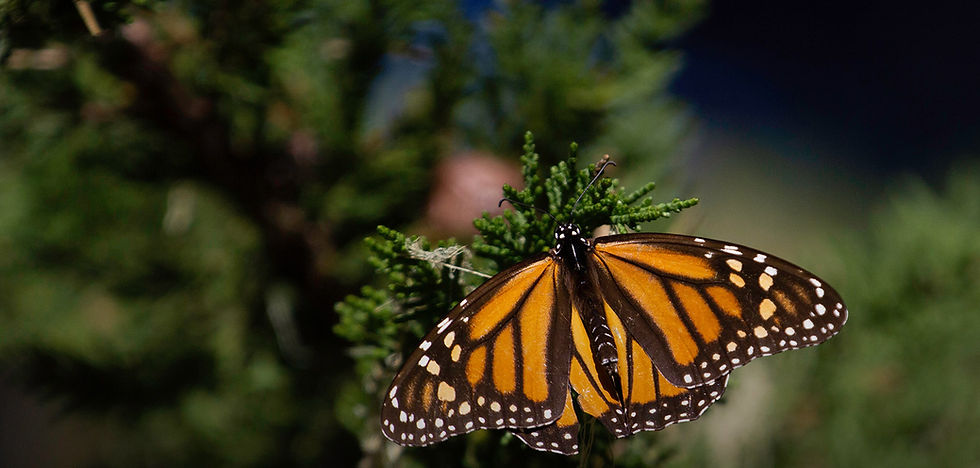
MONARCH OVERWINTERING
Monterey County Region
Monterey County is home to monarch butterflies that overwinter from October to March, with a peak season occurring between November and January. The largest concentration of overwintering monarchs in this area is at the Pacific Grove Monarch Sanctuary. Although less numerous, monarchs cluster at Andrew Molera State Park in Big Sur in certain years.
The Pacific Grove Museum of Natural History conducts a weekly count of the monarch population in the Sanctuary. Their website also provides information on its address, parking, and additional details.
Other parts of California
Outside of Monterey County, monarch butterflies can be found in various overwintering sites along coastal California. Two of the largest publicly accessible sites are Pismo Beach Butterfly Grove, located in San Luis Obispo County and Natural Bridges State Park, situated in Santa Cruz County.
Monarchs also find their way onto private properties. It is crucial for landowners to verify whether monarchs inhabit their land before proceeding with tree removal or construction activities. To view a complete list of monarch butterfly overwintering sites in California, check out this interactive map from the Western Monarch Count.
Nonmigratory populations in California
Recently, nonmigratory, winter-breeding monarch populations have emerged where non-native tropical milkweed (Asclepias curassavica) has been planted in urban gardens. Unlike native milkweeds that die back in winter, tropical milkweed remains green throughout the season. When monarchs encounter milkweed in the late fall or winter, it can prompt them to reproduce instead of entering a reproductive pause and clustering in overwintering sites. Monarchs can now be found year-round in cities like San Jose, Oakland, Los Angeles, and San Diego.
If you see a monarch butterfly outside of its typical overwintering location, do not assume it is lost or in distress. Instead, consider taking a photograph of the monarch and uploading it, along with the geographic information to either iNaturalist or the Milkweed Mapper Community Science Project.

MIGRATION
Monarchs are the only butterflies known to migrate in North America. They can be found throughout the continent, but not all migrate to the same locations. Western monarchs travel to California from as far east as the Rocky Mountains and as far north as southern Canada. Their primary summer ranges include Oregon, Washington, Nevada, Idaho, and Arizona.
All throughout inland Monterey County, migrating monarch butterflies can be found outside of the overwintering season, particularly in late fall and early spring as they migrate to and from overwintering sites on the coast. Some of the butterflies leaving overwintering sites will stay in Monterey County to breed throughout the spring and summer.
In contrast, the larger eastern monarch population inhabits areas east of the Rocky Mountains. Their summer range extends all the way to the Atlantic Ocean and north to Canada. When its time to overwinter, they migrate to the Mexican states of Michoacan and the state of Mexico, where they cluster in oyamel fir trees at high elevations.
MONARCH BIOLOGY
Anatomy of a Monarch


Life Cycle

Egg
A female lays a single egg on the underside of a milkweed leaf. While she can lay up to 400 eggs, this number depends on the availability of milkweed. Fewer milkweed plants result in fewer eggs. The egg is approximately the size of a sesame seed and hatches in 2-3 days.
Photo courtesy of J. Stagg

Caterpillar
The tiny larva that emerges from the egg is known as a caterpillar. Its main task is to consume as much milkweed as possible. Although milkweed is toxic, the caterpillar retains the toxins, making it poisonous as well, warning predators of its toxicity by displaying its bright colors. As the caterpillar grows, it undergoes a series of molts, with each stage between molts referred to as an instar. The monarch caterpillar goes through five instars, and by the fifth instar, it can be 2,000 times heavier than at hatching. Overall, the caterpillar stage lasts about 2 weeks.
Photo courtesy of J. Stagg

Chrysalis
The “pupa” stage, known as a chrysalis in butterflies, involves a complete transformation. The chrysalis is formed from the caterpillar’s exoskeleton. During this time, muscle tissues dissolve and reorganize around the developing butterfly structure. This transformation takes about 10-14 days, resulting in a total of approximately 4 weeks from egg to adult, depending on environmental conditions.
Photo courtesy of J. Stagg

Emerging Adult
When the butterfly first emerges from the chrysalis, the abdomen is swollen, and its wings are tiny. As it flaps its wings for the first time, it pumps hemolymph (a blood-like substance) into its wings, allowing them to expand and reach their full size.
Photo: Andy Reago & Chrissy McClarren, CC BY 2.0, via Wikimedia Commons

Adult Butterfly
Once it becomes an adult, a butterfly does not grow any larger. It no longer feeds exclusively on milkweed, but instead, it consumes nectar from a variety of flowering plants. For summer, spring, and non-migratory monarch butterflies, the adult finds mates, lays eggs, and lives for about 2 more weeks (for a total lifespan of 6-8 weeks). Other than during mating, adult butterflies are solitary. Overwintering adults are different; they possess instincts to migrate and cluster together, which brings them into closer proximity than non-migratory butterflies. These adults can live for 6 to 9 months and become sexually mature only in the last two months of their lifespan, at the end of the overwintering season.
Photo courtesy of J. Stagg


